The Overlooked Training Modality
Walk into any gym and you'll find men bench pressing, deadlifting, and running on treadmills. Walk to the pool and you'll usually find it half-empty — maybe a few older adults doing leisurely laps. This is a missed opportunity of massive proportions.
Swimming is one of the most effective total-body conditioning tools available. It builds muscular endurance, cardiovascular fitness, shoulder stability, and core strength while placing virtually zero impact stress on joints. It's the reason professional athletes across every sport — from basketball to MMA to cycling — include pool work in their training.
The Physiology of Swimming
Full-Body Muscle Recruitment
Unlike running (primarily lower body) or cycling (primarily quadriceps and glutes), swimming engages virtually every major muscle group in the body simultaneously. A 2015 EMG analysis in the Journal of Sports Sciences found that freestyle swimming activated the:
- Latissimus dorsi (primary pulling muscles)
- Pectoralis major (chest)
- Deltoids (shoulders)
- Triceps (during the push phase of each stroke)
- Core musculature (transverse abdominis, obliques, and erector spinae maintain body position)
- Quadriceps and hamstrings (during the kick)
- Hip flexors and glutes (stabilization and propulsion)
A single lap of freestyle engages more total muscle mass than almost any land-based exercise. This is why swimming burns an extraordinary number of calories — approximately 400-700 per hour depending on intensity and stroke, according to data from the Compendium of Physical Activities.
Cardiovascular Conditioning
Water's density (about 800 times that of air) creates constant resistance that the cardiovascular system must overcome. Horizontal body position also redistributes blood differently than land exercise — the heart doesn't have to fight gravity to return blood from the legs, which increases stroke volume (the amount of blood pumped per beat).
A 2016 study in Heart & Lung found that regular swimmers had significantly lower resting heart rates, better blood pressure profiles, and superior VO2 max compared to sedentary controls. A 2017 meta-analysis in British Journal of Sports Medicine concluded that swimming produced cardiovascular benefits comparable to running and cycling.
Joint-Friendly Training
Buoyancy reduces effective body weight by approximately 90% in chest-deep water, virtually eliminating impact forces on joints. This makes swimming ideal for men with knee problems, arthritis, lower back issues, or recovering from injuries.
A 2016 study in The Journal of Rheumatology found that swimming was as effective as cycling for reducing joint pain and stiffness in people with osteoarthritis, while also improving functional capacity.
Strokes and Their Benefits
Freestyle (Front Crawl)
The most efficient stroke and the best starting point for beginners. Primarily targets the lats, deltoids, pectorals, and core. Energy cost: approximately 8-11 METs (moderate to vigorous intensity).
Backstroke
Excellent for counteracting the hunched posture of desk work. Targets the posterior deltoids, rhomboids, trapezius, and triceps — muscles that are often neglected in gym-based training. Swimming backstroke regularly can significantly improve shoulder health and posture.
Breaststroke
The most technical stroke, with significant demand on the hip adductors, chest, and inner thighs. The frog kick motion provides hip mobilization that complements the linear movements of squatting and deadlifting. Lower energy cost than freestyle, making it suitable for recovery sessions.
Butterfly
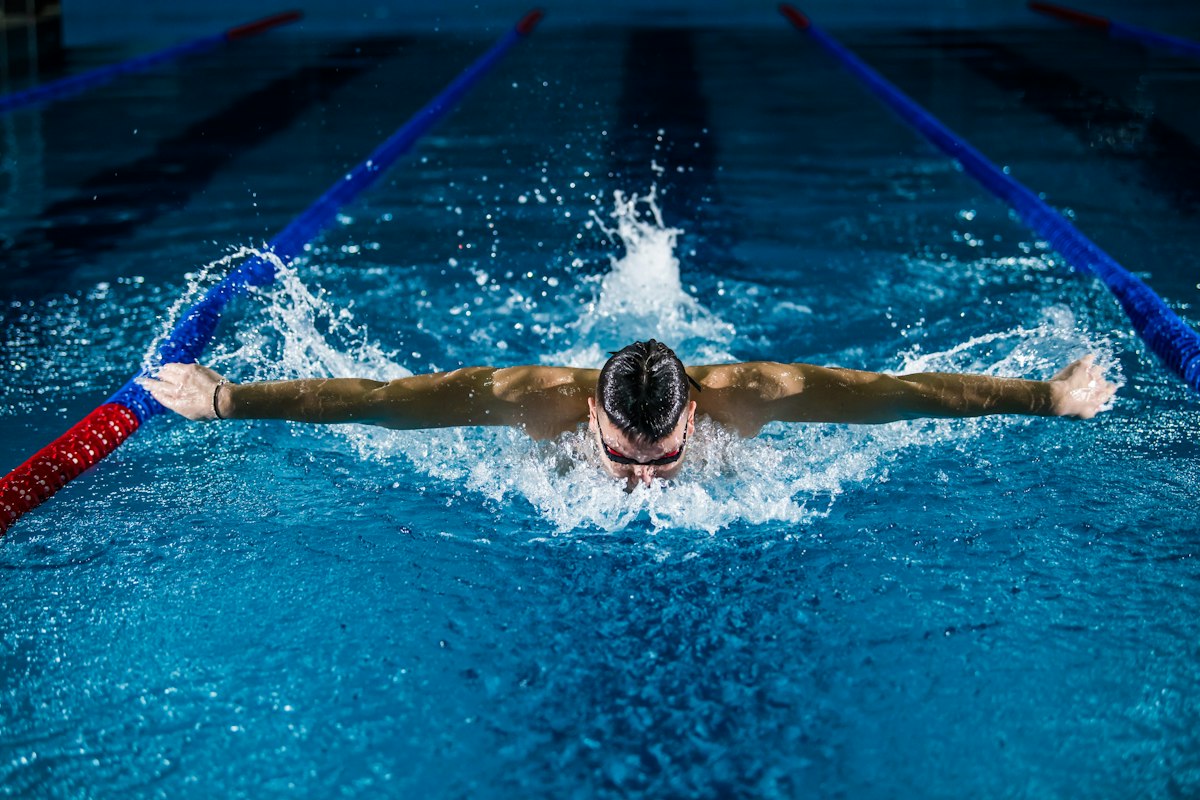
The most demanding stroke, requiring explosive power from the lats, chest, shoulders, and hip flexors. Butterfly burns the most calories per unit time and builds exceptional core strength through the undulating "dolphin kick" motion. Not recommended for beginners until technique is solid.
A 12-Week Beginner-to-Intermediate Program
Phase 1: Foundation (Weeks 1-4)
Focus on technique and comfort in the water. Swim 3 times per week.
Typical session (30-35 minutes):
- 200m easy warm-up (freestyle, use a kickboard if needed)
- 4 × 50m freestyle with 20 seconds rest (focus on breathing technique)
- 4 × 25m backstroke with 15 seconds rest
- 4 × 50m pull (with pull buoy between legs) with 20 seconds rest
- 200m easy cool-down
Key technique cues for freestyle:
- Rotate your body along the long axis with each stroke (don't swim flat)
- Breathe by turning your head, not lifting it (one goggle should stay in the water)
- Enter the water with fingertips first, hand angled slightly outward
- Kick from the hips, not the knees — small, fast flutter kick
Phase 2: Building Volume (Weeks 5-8)
Increase total distance and introduce interval work. Swim 3-4 times per week.
Typical session (40-45 minutes):
- 300m easy warm-up (100 free/100 back/100 free)
- 6 × 100m freestyle at moderate effort, 15 seconds rest
- 4 × 50m sprint freestyle, 30 seconds rest
- 4 × 100m alternating strokes (free/back/free/back), 20 seconds rest
- 200m easy cool-down with technique focus
Phase 3: Performance (Weeks 9-12)
Higher intensity intervals and increased total yardage. Swim 4 times per week.
Typical session (50-60 minutes):
- 400m warm-up (mixed strokes)
- 8 × 100m freestyle at 80% effort, 10 seconds rest
- 4 × 200m pull (with pull buoy), descending effort (each faster than the last), 20 seconds rest
- 8 × 50m sprint (choice stroke), 20 seconds rest
- 200m easy cool-down
By week 12, you should be comfortable swimming 2,000-2,500 meters per session at varying intensities.
Swimming for Lifters
If your primary training is in the weight room, swimming can serve as an exceptional complement rather than a replacement:
Active recovery: A 20-30 minute easy swim on rest days increases blood flow, reduces muscle soreness, and provides gentle range-of-motion work without adding impact stress. A 2010 study in the International Journal of Sports Medicine found that active recovery in water reduced next-day DOMS (delayed-onset muscle soreness) compared to passive rest.
Shoulder prehabilitation: The rotational demands of freestyle and backstroke strengthen the rotator cuff, serratus anterior, and lower trapezius — muscles that are critical for healthy overhead pressing and bench pressing but are often underdeveloped in lifters.
Cardiovascular conditioning without leg fatigue: Using a pull buoy (foam float between the legs) isolates the upper body, allowing you to get a cardiovascular workout without taxing legs that may be recovering from a heavy squat session.
Breathing efficiency: The restricted breathing pattern of swimming (you can only breathe when your face is out of the water) naturally improves CO2 tolerance, diaphragmatic strength, and breathing efficiency — all of which transfer to better performance under a heavy barbell.
Getting Started
The biggest barrier to swimming is technique, not fitness. Poor technique makes swimming exhausting and frustrating, which is why many fit men avoid the pool. Consider:
- Take a few lessons: Even 3-4 sessions with an instructor can transform your efficiency in the water
- Start with drills, not laps: Catch-up drill, fingertip drag, and side-kick drill build body position and stroke mechanics
- Use equipment: Fins, pull buoys, and kickboards help isolate weaknesses and make sessions more manageable
- Be patient: Swimming has a steeper technique learning curve than running or cycling, but the payoff is a uniquely versatile training tool
The pool is the most underutilized training space in any gym. The men who discover it gain a low-impact, full-body conditioning tool that supports their strength training, protects their joints, and builds a cardiovascular engine that translates to every other physical pursuit.
Comments
Sign in to join the conversation
Sign In