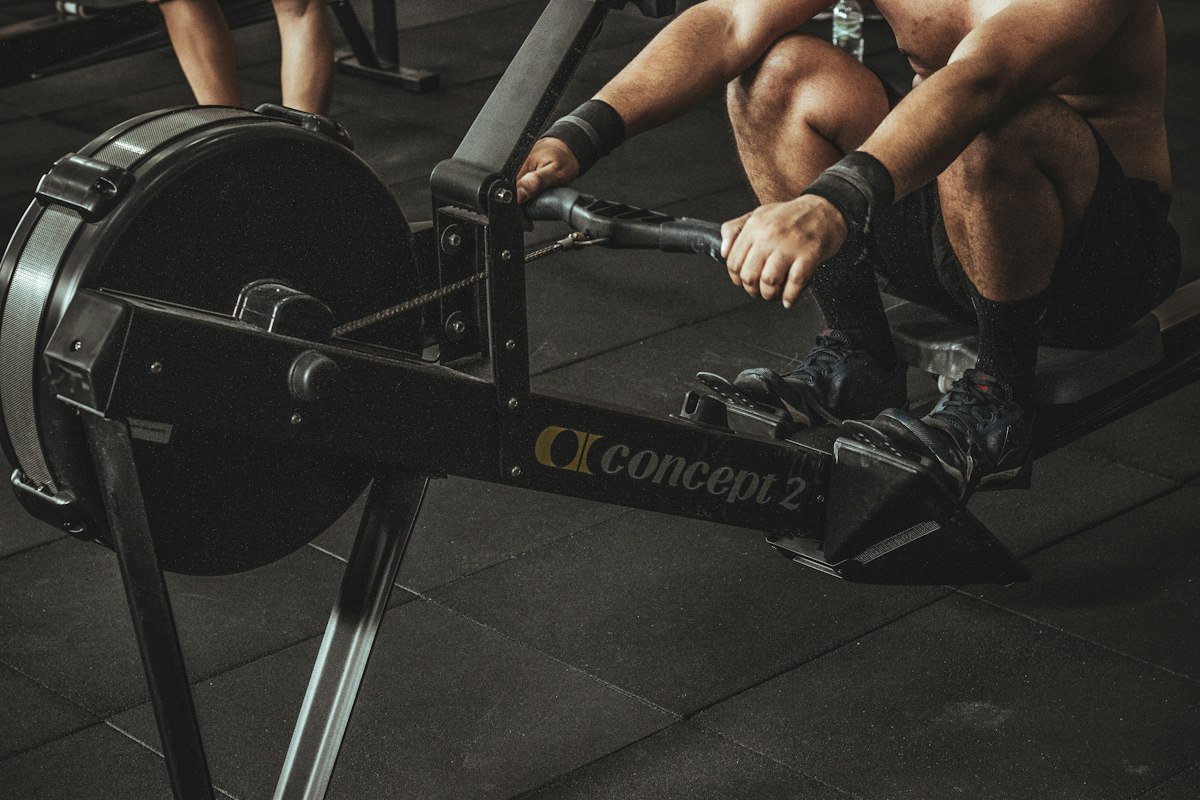
The Most Underused Machine in the Gym
In most commercial gyms, the rowing machines (ergometers) sit in a corner, gathering dust, while treadmills and ellipticals command the prime real estate. This is a mistake of enormous proportions. Rowing engages 86% of the body's musculature in a single, low-impact movement pattern — a claim no other piece of cardio equipment can match.
A 2015 study in the Annals of Rehabilitation Medicine compared energy expenditure and muscle activation across cardio modalities and found that rowing produced the highest caloric burn per minute of any machine-based exercise, while simultaneously activating the quadriceps, hamstrings, glutes, core, lats, rhomboids, biceps, and forearm flexors.
The Biomechanics of the Rowing Stroke
The rowing stroke consists of four phases, each recruiting different muscle groups in a sequential chain:
1. The Catch (Starting Position)
Shins vertical, arms extended, torso leaning forward from the hips with a flat back. The quadriceps and hip flexors are loaded, ready to initiate the drive. This position requires adequate ankle dorsiflexion and hip mobility — deficits that become immediately apparent on the rower.
2. The Drive
The most powerful phase. It proceeds in a specific order:
- Legs first: The quadriceps and glutes extend the knees and hips, generating roughly 60% of the stroke's power. Research from the Journal of Sports Sciences (2009) using instrumented rowing ergometers confirmed that leg drive accounts for the majority of force production in both elite and recreational rowers.
- Back swing: Once the legs are nearly extended, the torso swings from forward lean to slight backward lean, activating the erector spinae, rhomboids, and rear deltoids.
- Arm pull: The arms finish the stroke by pulling the handle to the lower ribs, engaging the latissimus dorsi, biceps, and forearm flexors.
3. The Finish
Handle at the lower ribs, legs extended, slight backward lean (roughly 15 degrees past vertical). The core stabilizes the torso, preventing excessive lean.
4. The Recovery
Arms extend first, then the torso pivots forward, and finally the knees bend to slide the seat back to the catch. The recovery should take approximately twice as long as the drive — a 1:2 drive-to-recovery ratio that ensures controlled, efficient movement.
Health Benefits Backed by Research
Cardiovascular Fitness
Rowing is a potent cardiovascular stimulus. A 2019 study in PLOS ONE compared 8 weeks of rowing versus running at matched intensities in previously sedentary adults. Both groups showed statistically equivalent improvements in VO2max (9-12%), resting heart rate, and blood pressure. The rowing group, however, reported significantly less joint pain.
Full-Body Strength Endurance
Unlike cycling (lower body dominant) or running (limited upper body involvement), rowing develops strength endurance across the entire kinetic chain. A 2014 study in the British Journal of Sports Medicine found that 8 weeks of rowing-based training improved grip strength by 12%, leg press 1RM by 8%, and seated row 1RM by 15% in untrained adults — simultaneously.
Low Impact
Rowing is non-weight-bearing: the feet stay planted on footplates, and the body glides on a rail. There is no ground-reaction force. A 2017 review in Sports Medicine identified rowing as one of the lowest-impact high-calorie-expenditure activities, making it ideal for individuals with joint pain, osteoarthritis, or those recovering from lower-extremity injuries.
Caloric Expenditure
A 2020 analysis from the Harvard T.H. Chan School of Public Health estimated that a 155-pound person burns approximately 369 calories per 30 minutes of vigorous rowing — exceeding the caloric cost of stationary cycling (391 at high intensity), stair climbing (223), and elliptical training (335).
Programming Rowing Workouts
For Beginners: The Foundation (Weeks 1-4)
Focus on technique before intensity. Row at a stroke rate of 18-22 strokes per minute (SPM) with a moderate drag factor setting (3-5 on a Concept2).
Workout A: Steady State
- 3 × 8 minutes at conversational pace, 2-minute rest between sets
- Focus: consistent split time (time per 500m), smooth rhythm
Workout B: Intervals
- 6 × 2 minutes at moderate effort, 2-minute rest
- Focus: leg drive initiation, proper sequencing
For Intermediate Rowers: Building Capacity (Weeks 5-12)
Workout A: Long Steady State
- 30-40 minutes at 60-70% of max heart rate
- Stroke rate: 20-24 SPM
Workout B: Pyramid Intervals
- 1 min hard / 1 min easy → 2 min hard / 1 min easy → 3 min hard / 1 min easy → 4 min hard / 1 min easy → back down
- Total: ~25 minutes of work
Workout C: Sprint Intervals
- 8 × 250m at max effort, 90-second rest between intervals
- Track split times — aim for consistency
For Advanced Athletes: Performance Training
The 2K Test: The benchmark of rowing fitness. A 2019 study in the International Journal of Sports Physiology and Performance validated the 2,000m ergometer test as a reliable predictor of aerobic capacity, with a correlation of r = 0.92 between 2K time and VO2max.
Competitive benchmarks (for reference, not required for health):
- Recreational male: sub-8:00
- Recreational female: sub-9:00
- Competitive male: sub-6:30
- Competitive female: sub-7:15
Common Mistakes and How to Fix Them
1. Pulling with the Arms First
The most common error. When the arms pull before the legs drive, you lose 60% of your power potential and place excessive stress on the lower back. Fix: Think "legs, back, arms" on the drive and "arms, back, legs" on the recovery. Practice the "legs only" drill — rowing with arms extended and stationary — to groove the pattern.
2. Rounding the Lower Back
A flexed lumbar spine under load invites disc injury. Fix: Hinge from the hips with a braced core. If you can't maintain a neutral spine at the catch, shorten your forward reach — mobility will improve with practice.
3. Setting the Damper Too High
The damper lever (1-10 on a Concept2) controls airflow to the flywheel, not resistance. Higher settings simulate rowing a heavier boat, not harder exercise. Most competitive rowers train at damper 3-5. Setting it to 10 is like cycling in the highest gear — you'll fatigue quickly with suboptimal power output. A 2013 Concept2 technical note confirmed that performance times are nearly identical across damper settings for trained rowers.
4. Rushing the Recovery
A jerky, fast recovery kills rhythm and efficiency. The recovery is your rest. Maintain the 1:2 drive-to-recovery ratio: if your drive takes 1 second, your recovery should take 2.
Rowing as Complementary Training
Rowing integrates exceptionally well with other training modalities:
- Paired with strength training: Use 10-15 minutes of steady-state rowing as a warm-up. The full-body nature primes every muscle group for lifting.
- As active recovery: Low-intensity rowing (18-20 SPM, conversational pace) on rest days promotes blood flow without the eccentric muscle damage of running.
- For HIIT conditioning: 500m sprint intervals with 1:1 rest-to-work ratios provide potent cardiovascular stimulus in under 20 minutes.
The rowing machine may lack the social cachet of running or the adrenaline of cycling, but the data speaks clearly: no other single piece of equipment provides this combination of full-body engagement, cardiovascular conditioning, strength development, and joint-sparing mechanics.
Comments
Sign in to join the conversation
Sign In