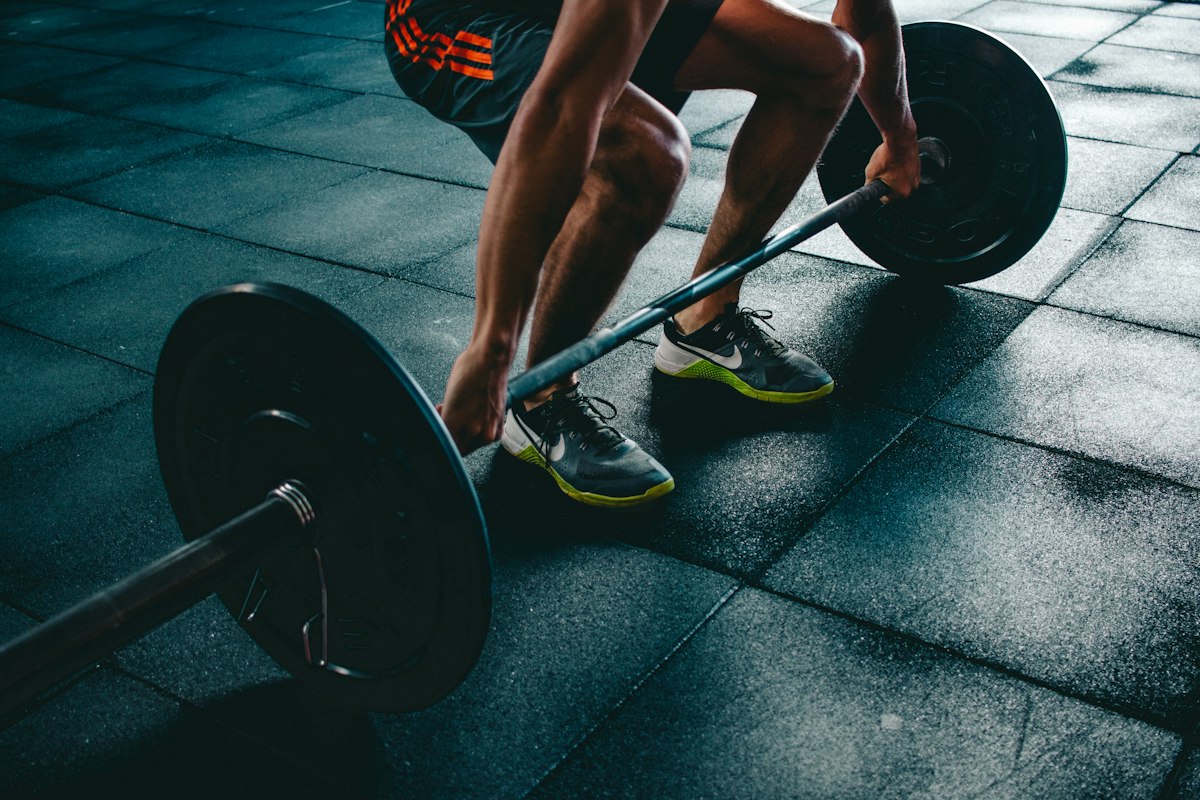
One Exercise to Rule Them All
If you could only perform one exercise for the rest of your life, the deadlift would be the rational choice. No other single movement trains as many muscle groups, produces as much systemic hormonal response, or carries over as directly to real-world strength and function.
The deadlift works your entire posterior chain — glutes, hamstrings, and erectors — along with your quadriceps, lats, traps, rhomboids, forearms, and core. In a single repetition, you're loading roughly 70% of your total skeletal muscle mass.
As legendary strength coach Mark Rippetoe puts it: "The deadlift is more functional in that it's very hard to imagine a more useful application of strength than picking heavy shit up off the ground."
The Muscles at Work
The deadlift is a full-body exercise. Here's what's firing and when:
Primary Movers
- Glutes: The primary hip extensor — produces the majority of force to stand up with the weight
- Hamstrings: Assist hip extension and stabilize the knee
- Quadriceps: Extend the knee during the initial pull off the floor
- Erector spinae: Maintain spinal extension throughout the lift
Secondary/Stabilizing Muscles
- Latissimus dorsi: Keep the bar close to the body by creating upper back tension
- Trapezius and rhomboids: Maintain upper back position and scapular retraction
- Core (transverse abdominis, obliques): Brace the spine under load, creating intra-abdominal pressure
- Forearms and grip: Hold the bar — grip strength is often the limiting factor for beginners
- Calves and feet: Maintain ground contact and tripod foot position
Conventional Deadlift: Step-by-Step Technique
Setup
- Bar position: Over mid-foot (approximately 1 inch from your shins)
- Stance width: Hip-width apart, feet slightly turned out (5-15 degrees)
- Grip: Just outside your knees, double overhand or mixed grip
- Shin angle: Shins touch the bar when you drop your hips to your starting position
The Pull
- Brace: Take a deep breath into your belly, engage your core like you're about to get punched
- Wedge: Push your hips down and your chest up until you feel tension in your hamstrings — "take the slack out of the bar"
- Drive: Push the floor away with your legs. The bar should leave the floor smoothly, not jerk
- Bar path: Straight vertical line, as close to your body as possible. The bar should lightly drag up your shins and thighs
- Lockout: Squeeze your glutes to drive your hips to the bar. Stand tall — don't hyperextend your lower back
The Descent
- Hip hinge first: Push your hips back, maintaining a neutral spine
- Once the bar passes your knees, bend your knees to lower it to the floor
- Control the weight — don't just drop it (unless training maximal loads on a platform)
Common Errors to Avoid
- Rounding the lower back: The single most dangerous error. Maintain a neutral spine throughout. If your back rounds, the weight is too heavy or your bracing is insufficient.
- Pulling with your arms: Your arms are hooks. The force comes from your legs and hips.
- Bar drifting forward: Keeps the bar in contact with your body. Any forward drift increases the moment arm on your spine.
- Jerking the bar: Leads to bicep tears and technical breakdown. Smooth, progressive tension.
- Looking up: Hyperextending the cervical spine. Pack your chin and maintain a neutral neck.
Deadlift Variations
Sumo Deadlift
Wide stance, hands inside the knees. Reduces range of motion, shifts emphasis to the quads and adductors, and is generally easier on the lower back. Favored by many powerlifters and those with longer torsos.
Romanian Deadlift (RDL)
Starts from the top (standing position) and descends under control to approximately mid-shin, maintaining a slight knee bend. The RDL isolates the hamstrings and glutes while maintaining continuous tension. Excellent for hypertrophy and hamstring development.
Trap Bar (Hex Bar) Deadlift
Allows a more upright torso position and centers the load around the body rather than in front. Research in the Journal of Strength and Conditioning Research shows the trap bar deadlift produces less shear force on the lumbar spine. An excellent option for beginners and athletes.
Deficit Deadlift
Standing on a 1-2 inch platform increases the range of motion, building strength off the floor. Used as an accessory for lifters who struggle with the initial pull.
Pause Deadlift
Pausing for 2-3 seconds with the bar at knee height eliminates momentum and builds tremendous positional strength. Invaluable for improving technique and mid-range strength.
Programming the Deadlift
For Beginners
- Frequency: 2 times per week (one heavy, one light/technique day)
- Sets/Reps: 3-5 sets of 5 reps at 70-80% of estimated 1RM
- Progression: Add 5-10 lbs per week (linear progression)
For Intermediates
- Frequency: 1-2 times per week
- Sets/Reps: Vary by block — accumulation phases (3-4 sets of 6-8 at 70-75%), intensification phases (4-6 sets of 2-4 at 80-90%)
- Progression: Weekly or bi-weekly increments
For Advanced Lifters
- Frequency: 1-2 times per week (including variations)
- Programming: Periodized approaches like 5/3/1, conjugate, or DUP
- Progression: Monthly or block-based
Warm-Up Protocol
- Foam roll glutes and hamstrings — 30 seconds each
- Band pull-throughs — 2×15
- Bodyweight hip hinges — 2×10
- Empty bar deadlifts — 1×10
- Progressive warm-up sets: 40% × 5, 60% × 3, 75% × 2, 85% × 1, then working sets
The Deadlift and Injury: Separating Fact From Fiction
The deadlift has an undeserved reputation as a back-breaker. In reality, when performed with proper form and progressive loading, the deadlift is one of the most effective exercises for building a resilient, injury-resistant back.
A 2015 systematic review in the British Journal of Sports Medicine found that resistance training — including deadlifts — reduced sports injuries by approximately one-third and overuse injuries by nearly 50%. The loaded hip hinge pattern strengthens the exact muscles and connective tissues that protect the spine during daily activities.
Injuries occur when:
- Load exceeds the lifter's current capacity (too much weight, too fast)
- Technique breaks down (rounding the lower back under heavy load)
- Recovery is inadequate (insufficient sleep, nutrition, or deload weeks)
- Pre-existing conditions aren't accounted for (disc injuries, stenosis)
If you have a current back injury, work with a qualified coach or physical therapist to determine when and how to deadlift safely. For the vast majority of healthy adults, the deadlift is not just safe — it's therapeutic.
Why You Should Deadlift
Beyond the obvious strength and muscle-building benefits, deadlifts:
- Build functional real-world strength: Picking up children, moving furniture, carrying groceries — all hip hinge patterns
- Increase bone mineral density: Axial loading is the most potent stimulus for bone growth, protecting against osteoporosis
- Improve posture: Strengthening the posterior chain counteracts the forward-hunched posture caused by desk work
- Boost hormonal response: Heavy compound movements produce the greatest acute elevations in testosterone and growth hormone
- Build mental toughness: There's something uniquely confidence-building about pulling heavy weight off the ground
The deadlift is foundational. It's primal. And when done right, it will build a body that's as capable as it looks.
Comments
Sign in to join the conversation
Sign In